
Case study
Ask Charlotte
Transforming AI beauty advice into confident product decisions
- Role
- Lead Product Designer
- Platforms
- Web and app
- Focus
- Conversational AI, UX strategy, UI systems and experimentation
- Team
- Product, AI engineering, data, research, content and development
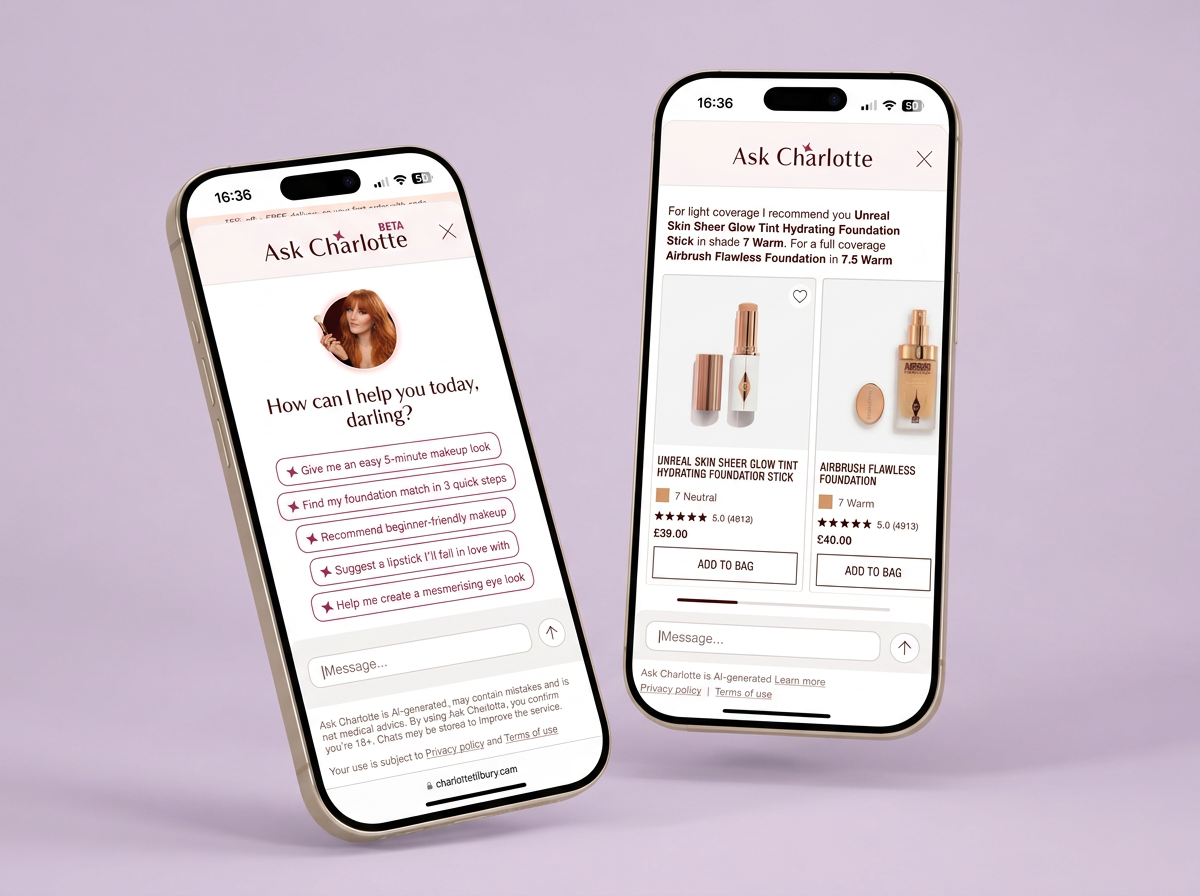
Ask Charlotte is Charlotte Tilbury’s conversational AI beauty assistant, designed to combine personalised product recommendations with the warmth and expertise of a makeup artist.
This has been a multidisciplinary team effort across product, design, AI engineering, data, research, content and development. I initially joined the project as maternity cover before taking on lead design responsibility for the tool and its next phase of development.
From pilot to product
The experience began in 2025 as Easy Beauty Expert, an early pilot created to assess whether customers would engage with an AI-powered beauty advisor.
The pilot helped us understand how customers approached conversational beauty advice. Users responded best when they were given clear, beauty-led starting points rather than being expected to begin with an open-ended question.
These early learnings shaped the evolution of the experience into Ask Charlotte: a more integrated, recognisable and intent-led product built around Charlotte’s artistry and authority.
Testing demand at scale
Ask Charlotte was soft launched to 50% of web and app users to understand customer demand, how people used the experience and whether conversation translated into confident product choice.
The launch proved that customers were willing to engage. However, it also revealed a gap between beginning a conversation and feeling confident enough to act on the recommendation.
Almost half of customers who opened Ask Charlotte went on to start a conversation, and 47% of those conversations reached a product recommendation. The largest drop-off came when customers needed to decide whether they trusted that recommendation enough to continue.
Exposure to Ask Charlotte also significantly increased engagement with Charlotte Tilbury’s digital beauty tools:
- Web usage increased from 8.0% to 9.6% — a 20.3% relative uplift.
- App usage increased from 20.7% to 21.7% — a 4.6% relative uplift.
Commercial results had not yet reached statistical significance. This gave us a clear design challenge: move beyond generating engagement and help customers progress from conversation to confident product choice.
What customers needed
Guidance, not open chat
Most customers were beginner or intermediate beauty users looking for help narrowing their choices. Around 80% of conversations were research-led, while only 18% showed immediate purchase intent.
A clearer starting point
Only around 20% of sessions began with free text. Most customers selected a conversation starter, showing that prompt design and choice architecture are fundamental parts of the experience.
Confidence to continue
Customers wanted clarity, validation and a low-risk next step. Ask Charlotte achieved a 4.0 out of 5 CSAT score, with 72.4% of customers rating the experience four or five stars, but trust weakened when advice felt repetitive, inaccurate or disconnected from their needs.
Foundation shade matching emerged as the strongest opportunity because it combined the highest customer demand with the greatest need for accuracy and reassurance.
Listening after launch
Our exit-intent survey showed both the value of Ask Charlotte and where the experience needed to improve. Across 287 responses, 51% found the tool helpful and 32% left because they had received what they needed. Shade matching was the leading customer need at 43%.
Where the experience fell short, customers highlighted irrelevant or discontinued recommendations, repetitive questioning and technical errors. They also wanted more visual support, including photo upload, virtual try-on and access to a human advisor.
Designing confidence into the conversation
The next phase focuses on making Ask Charlotte easier to start, easier to understand and easier to act on. Instead of relying on long passages of conversational copy, we are building reusable UI components that present decisions and recommendations more clearly.
Clear ways to start
Intent-led conversation starters help customers identify the right journey immediately, reducing the effort of deciding what to type.
Actionable recommendations
Richer product cards bring the recommendation, shade, reviews, price and add-to-bag action together, making the next step clearer.
Shorter decision paths
Clearer formatting and focused questions help customers move through the journey without losing context or becoming trapped in repetitive loops.
From chat to guided shopping
The soft launch showed that Ask Charlotte should not become a broader, open-ended chatbot. Its greatest value lies in removing a specific purchase blocker quickly while preserving Charlotte’s warmth, charm and artistry.
Guided Decisioning moves the experience from chat support towards a guided shopping journey that helps customers choose the right product with confidence.
Move away from
- Long, effortful questioning
- Repetitive conversational loops
- Generic recommendations
- Multiple options with equal prominence
- Advice that feels functional but not reassuring
- Tone of voice being used as a substitute for trust
Move towards
- A direct answer first
- One clear best-fit recommendation
- A simple explanation of why it fits
- Suggested answer components
- Visual and product-led responses
- Stronger reassurance at the point of decision
- Charlotte’s warmth and authority throughout the journey
Improving the customer experience
The next phase of Ask Charlotte focuses on making the experience faster, clearer and more reassuring. We are building a stronger foundation for more accurate recommendations, better product guidance and more consistent experiences across web and app.
Next steps include:
- Reducing response times and improving clarity
- Guiding customers with more focused questions and suggested answers
- Making recommendations easier to understand and act on
- Improving product accuracy and availability
- Prioritising foundation shade matching as the first guided journey
- Continuing to test visual, product-led ways to build confidence
Together, these improvements will help customers move from conversation to confident product choice with less effort.